ServicesIron and sediment filtration
Iron and Sediment Filtration in Farmers Branch
Orange rings in the toilet, gritty faucet aerators and tan laundry usually trace back to rust particles or sediment riding in with your water. We test to find where it comes from, then install a filter at the main line sized to your home's flow.
Two Problems That Look Alike
Sediment is anything solid in the water: sand, flakes of pipe scale, bits of rust. Iron behaves differently depending on its form. Particulate iron has already oxidized, so it shows up red-brown right out of the tap. Dissolved iron runs clear, then turns cloudy and orange after it sits in a glass or hits air in a toilet tank. A screen or cartridge catches the first kind. The second kind has to be oxidized before any filter can hold it.
City water leaves treatment clean. It can pick up rust and scale on the way, from older cast-iron mains, from main repairs, and from the galvanized steel supply lines found in many homes built in the 1950s through the 1970s. Galvanized pipe corrodes from the inside, and every pressure swing knocks a little more loose.
That source matters. A filter where the water enters your home protects every fixture downstream of it. It cannot stop rust that starts in your own pipes after that point. We sort out which case you have before we suggest any equipment.
What You Get With the Job
Testing to find the source
We measure iron, manganese, turbidity and pH, taking one sample at the hose bib closest to the meter and another at a fixture inside. A clean outdoor sample next to a dirty indoor one means your plumbing, not the supply, is shedding the rust.
Spin-down screen for sediment
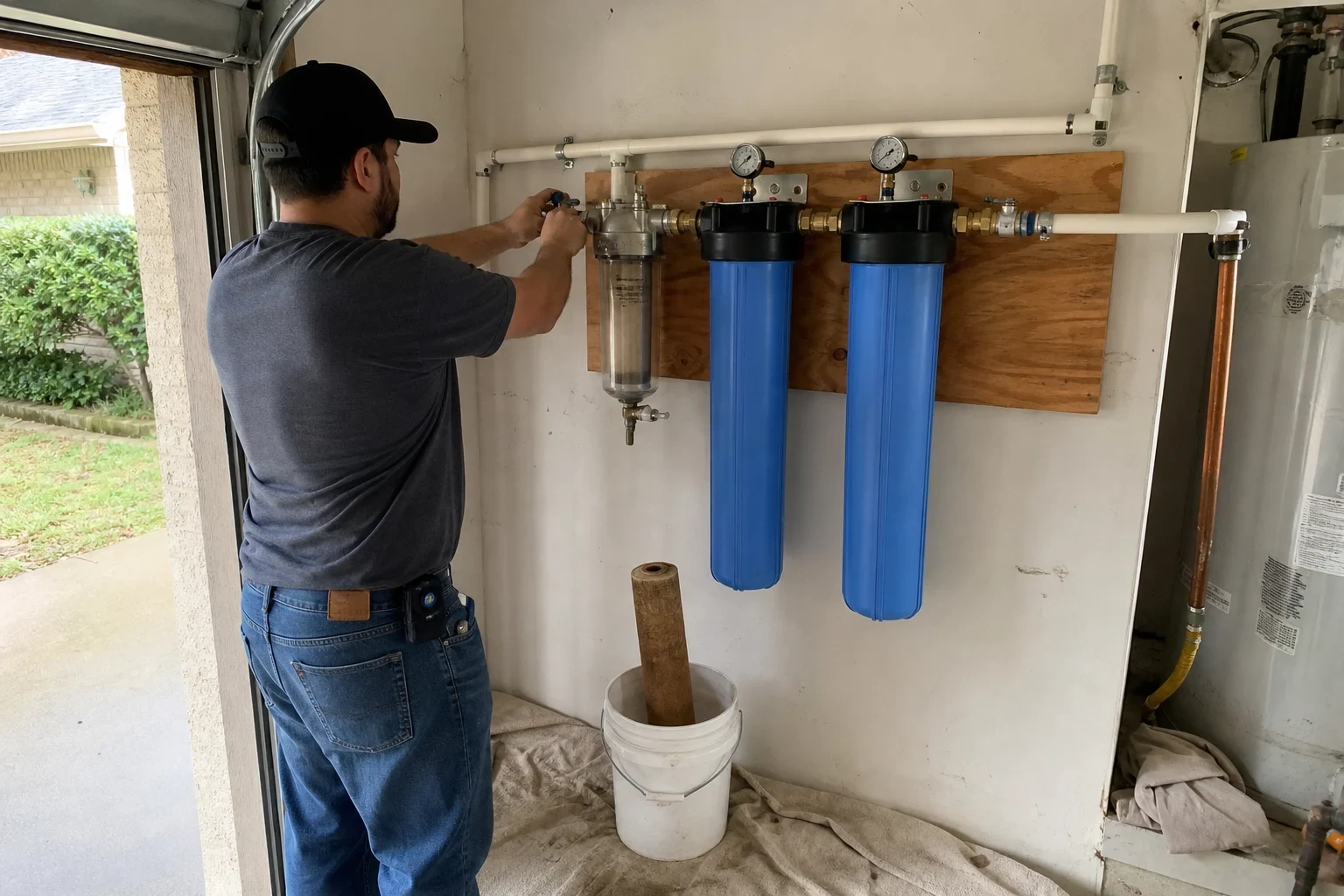
A see-through bowl holding a stainless steel mesh screen, with a flush valve at the bottom. It catches sand and scale flakes ahead of the finer cartridges, and you can tell at a glance when it is time to flush.
Big cartridge housings
For the whole house we install 4.5 by 20 inch housings fitted with pleated or spun polypropylene cartridges, typically rated 5 to 30 microns. The bigger size holds more debris and keeps pressure steady when two showers and the washer are going at once.
Iron media tank that backwashes
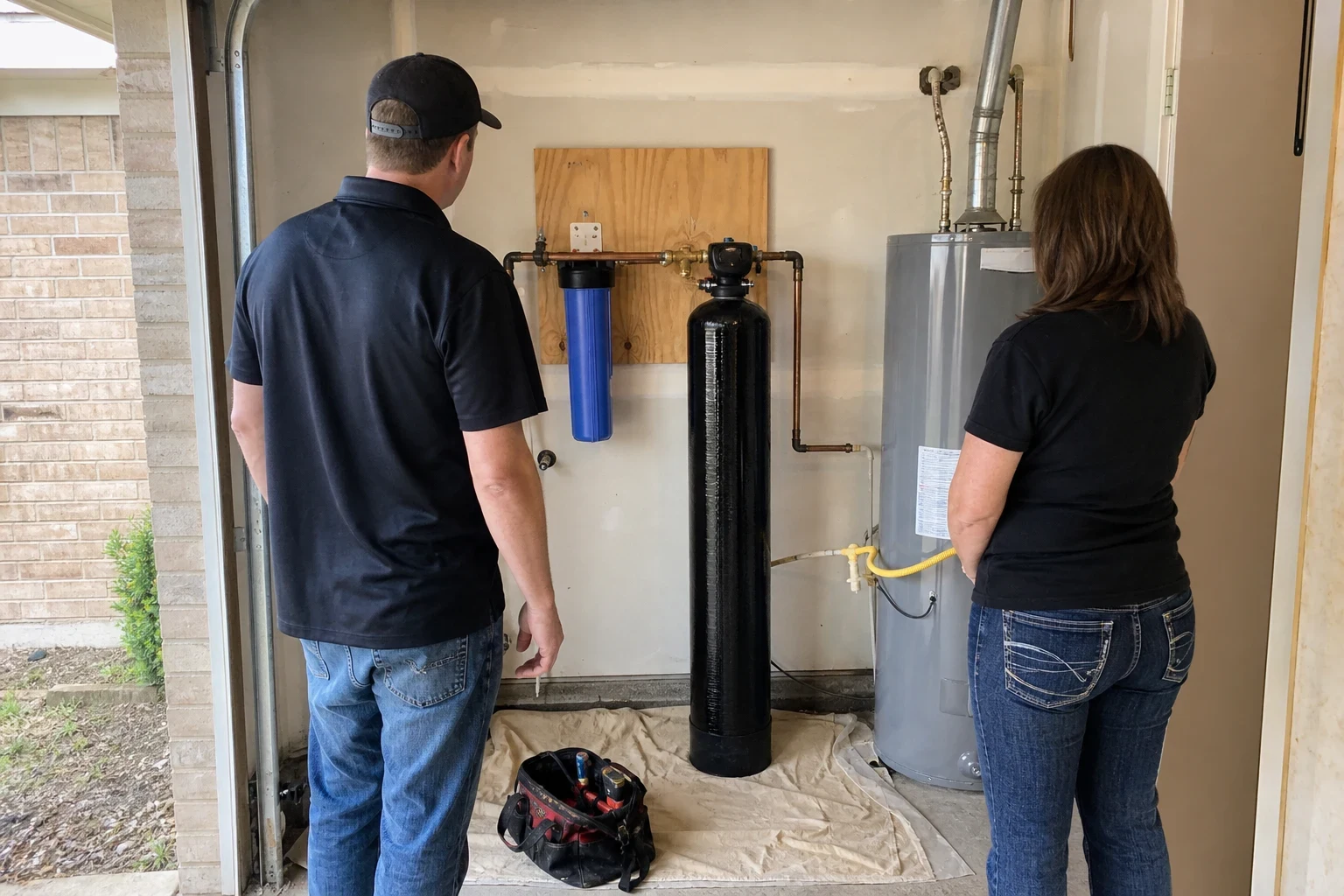
Heavy or mostly dissolved iron plugs cartridges quickly. A media tank turns the iron into particles and holds them, and a control valve backwashes the bed on a set schedule. It needs a drain line and an outlet close by.
Bypass and pressure gauges
Each install comes with a bypass to keep water flowing during service and gauges on both sides of the filter. When the two readings drift apart, a cartridge is filling up.
Signs Your Water Needs Iron or Sediment Filtration
Orange or brown toilet stains
Rings in the bowl and a rusty film inside the tank point to iron. Scrubbing helps for a week, then the color comes back.
Clogged aerators and showerheads
Unscrew a faucet aerator. Sand-like grit or dark flakes in the screen is sediment that is also collecting in valves and appliance inlets.
Rumbling water heater
Sediment settles on the bottom of a tank heater and gets trapped under it. The popping sound is water boiling beneath that layer, which also wastes energy.
Brown water after city work
A burst of discolored water after a main repair is stirred-up scale. If it happens often, a sediment stage keeps it out of your fixtures.
Water that changes in the glass
Clear from the tap but orange after an hour usually means dissolved iron. That calls for oxidizing media, not just a cartridge.
Dingy whites
Iron binds to fabric in the wash and turns whites tan. Bleach makes it worse by locking the rust in.
How a Job Runs
- 1
Talk it through and test
We start with a call about what you are seeing and when it happens. Then we sample at the meter side and inside your home so the results show where the iron or grit enters.
- 2
Recommendation and written estimate
We walk you through the numbers and give you a line-item estimate. If the problem is your own galvanized piping, we say so and explain what a filter can and cannot do about it.
- 3
Installation
We shut off the main, cut into the line where it enters, usually in the garage or at an exterior wall, and mount the bypass, housings and gauges. We pad the work area and handle a plumbing permit if the city requires one for the tie-in.
- 4
Start-up and handoff
We flush the system, check every joint for leaks and note the starting gauge readings. Before we leave, we show you how to change a cartridge and clean up the area.
What Changes the Price
The test results drive most of the cost. Occasional sediment calls for far less equipment than constant dissolved iron does. We price the job after testing, so you buy the filter your water requires and nothing larger.
- Kind of filter
- A spin-down screen paired with a single cartridge housing is the most basic setup. A backwashing media tank costs more at the start because it includes a control valve and a media bed.
- House size and flow
- Each added bathroom raises peak flow. Housings and tanks must be big enough to hold pressure steady when several fixtures are on together.
- Pipe type and where it runs
- Connecting to copper or PEX is simple. Adapting from galvanized steel, working in a tight spot or reaching a main inside a wall takes more labor.
- Drain and electrical access
- A backwashing system needs both a drain and an outlet. When neither is nearby, running them becomes part of the work.
- Upkeep over time
- Cartridges get swapped on a schedule, and media wears out eventually. We go over those costs at the start so they do not catch you off guard.
Iron and Sediment Filtration Questions
Something not covered here? (972) 687-7743
Will a sediment filter remove dissolved iron?
Not on its own. Dissolved iron passes through a cartridge as easily as water does. It has to be oxidized into particles first, which is what an iron media tank does. Our test tells us which form you have.
How often do the cartridges need changing?
It depends on how much debris your water carries. Watch the gauges. When the after-filter reading falls roughly 10 psi below the incoming reading, the cartridge is loaded. Our filter replacement and maintenance service can handle it on a schedule.
Will my showers feel weaker after the install?
They should not. With clean cartridges and housings matched to your peak demand, the difference at the showerhead is hard to notice. When people do lose pressure, the cause is nearly always a housing too small for the household or a cartridge left in far too long. We size equipment by flow rate and put gauges on both sides so a clogging cartridge shows up on the dial before you feel it.
The rust is coming from my own pipes. Will this help?
Only partly. Equipment at the point of entry has no reach past its own outlet, so when corroding galvanized lines inside the walls are the source, clean water leaves the filter and collects rust again before it reaches the tap. We will tell you that plainly. For drinking and cooking water, under-sink reverse osmosis at the kitchen sink is one practical option while you weigh longer-term fixes.
Can this go in with a carbon filter or softener?
Yes. A sediment stage ahead of whole-house carbon filtration keeps grit from clogging the carbon bed and shortening its life. We only add a softener if a hardness test supports it.
Find Out What Is in the Grit
A test at the meter and at your tap shows whether the problem is sediment, iron or your own pipes. From there we recommend only what fixes it.