ServicesUnder-sink reverse osmosis
Under-Sink Reverse Osmosis in Farmers Branch
We install under-sink reverse osmosis systems that feed a dedicated faucet with water for drinking, coffee and cooking. We test first, check your water pressure and cabinet space, and fit a system that suits your sink, your drain and how much water your household actually uses.
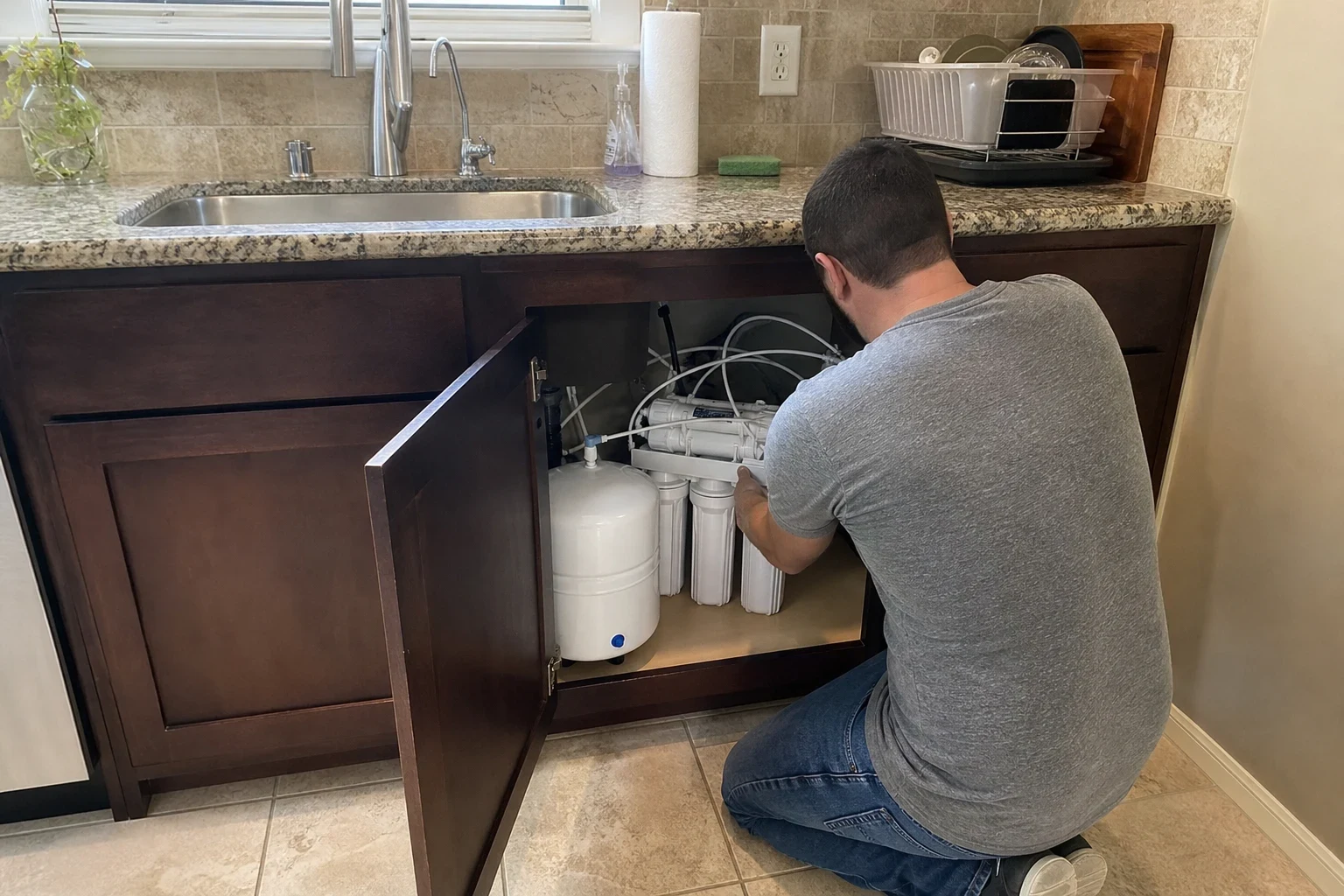
How an RO system treats water at your kitchen sink
A reverse osmosis unit forces water across a thin-film composite membrane whose openings are tight enough to stop dissolved metals, salts and many trace contaminants. Ahead of that membrane, a sediment prefilter traps grit, and a carbon block strips out chlorine or chloramine, both of which would otherwise damage the membrane. Behind it, a compact storage tank holds the treated water, and a carbon polishing filter improves the taste just before it reaches the faucet.
This is the system to choose when your concern is the water you drink, not the water you bathe in. A lot of Farmers Branch homes went up between the 1950s and the 1970s, and copper plumbing installed before 1986 may still have lead solder holding its joints together. Water can be in good condition when it leaves the city plant and still collect metals inside your own pipes. An RO unit at the sink handles that final stretch.
When taste and odor show up at every faucet in the house, whole-house carbon filtration is usually the better fit. We will tell you which of the two suits your home, or whether it needs both.
What the installation includes
- Pre-install water test
- We check total dissolved solids, hardness and line pressure before choosing a system. Those three numbers decide whether a standard unit will work or whether it needs a booster pump or a softer feed.
- Four- or five-stage system
- Sediment prefilter, carbon prefilter, RO membrane, pressurized storage tank and a carbon post-filter. We explain what each stage removes so you know what you are paying for.
- Dedicated faucet
- We mount a separate drinking water faucet through an existing sprayer or soap dispenser hole, or drill a new one. Granite and quartz tops get a diamond core bit and a slow, water-cooled cut.
- Supply and drain connections
- A feed adapter goes on the cold water angle stop, and a drain saddle clamps onto the sink tailpiece above the trap so brine water leaves cleanly.
- Optional refrigerator line
- If your fridge has an ice maker or water dispenser, we can run a tee from the RO output so it gets the same filtered water.
- Startup and flush
- We fill and drain the first tank to clear carbon fines and membrane preservative, then check every fitting for drips before we leave.
Signs an RO system belongs under your sink
Older copper or galvanized pipes
Homes plumbed before the 1986 lead solder ban can leach lead at joints, especially after water sits overnight. RO removes the large majority of dissolved lead at the point you drink from.
High TDS reading
A meter reading that seems high, or a white film left in kettles and on glasses, points to dissolved minerals that a membrane handles well.
You buy bottled water
Cases of bottled water and pitcher filters that need constant changes are a sign you want better drinking water without the hauling.
Flat or chemical taste
Disinfectant taste in coffee and tea is common with treated city water. The carbon stages take care of that before and after the membrane.
Someone in the house needs extra margin
Infants on formula, older relatives or anyone advised to limit sodium or trace metals often benefit from water with fewer dissolved solids.
What sets the price of an RO system
Most under-sink installs are straightforward, but a few details change the parts list and the time on site. We look at those during the test and give you a written, line-item estimate before any work starts, so the number does not move once we are under your sink.
Water pressure
Membranes want roughly 40 to 60 psi. Below that, output drops and waste water rises, so a low-pressure home may need a booster pump.
Countertop material
Using an existing hole is quickest. Drilling stone or quartz takes more time and a specialty bit than laminate does.
System features
Remineralization stages, a refrigerator line, a larger tank or a permeate pump that cuts waste water each add parts.
Cabinet layout
A crowded sink base with a disposal, water heater recirculation lines or a hot water dispenser can mean a remote tank in an adjacent cabinet.
How install day runs
- 1
Clear the cabinet
We ask you to empty the sink base. We check the space for the tank, usually about the size of a basketball, and look at the disposal and dishwasher lines so nothing crowds them.
- 2
Shut off and connect
We close the cold angle stop, fit the feed adapter, mount the filter manifold to the cabinet wall and set the drain saddle above the P-trap.
- 3
Faucet and tubing
We set the faucet, route the tubing neatly along the cabinet sides and keep runs short to reduce pressure loss.
- 4
Fill, flush and check
The first tank takes a few hours to fill. We flush it, retest TDS at the faucet to confirm the membrane is working, and show you where the shutoff and filter housings are.
Common questions about reverse osmosis
How much water goes down the drain with RO?
A typical unit drains several gallons for every gallon of treated water, with the exact ratio set by line pressure and water temperature. Adding a permeate pump or choosing a higher-efficiency membrane lowers that a good deal. Because it supplies just one faucet, the overall amount is minor next to a toilet flush or a laundry load.
Will RO take out minerals I'd rather keep?
It does pull out calcium and magnesium, along with the rest of what is dissolved in the water. Most of those minerals come from your diet rather than your glass. If you like the taste of water with minerals in it, we can fit a remineralization stage after the membrane.
When do the filters and membrane get replaced?
The sediment and carbon prefilters are typically swapped every 6 to 12 months. The membrane lasts two to four years, depending on your water and how much you draw. Our filter replacement and maintenance service can take care of both.
Does the RO faucet run slowly?
Yes, compared with your regular kitchen faucet, since it pulls from a pressurized storage tank. A pitcher takes a bit longer to fill, and the tank tops itself back up between uses.
Do I need a water test before buying RO?
We advise it. Testing confirms whether RO fits your water and flags high hardness or iron that would wear out the membrane early. If the results point to a different fix, our water testing page walks through the choices.
Get better drinking water from your own tap
Tell us about your sink, your countertop and what you want out of your water. We will walk through the test, the system and the cost before anyone picks up a wrench.